
Do Teachers want AI-support Ed-Tech?
Deploying any new disruptive technology comes with the challenge of understanding what the target users really need, and adapting the tool accordingly to fit their expectations. Within EdTech (Education Technology), users are primarily teachers, who face increasingly complex challenges as the educational landscape adjusts to today’s realities. EdTech can be a promising tool to help teachers meet the educational needs of the moment. However, technology cannot be pursued for the sake of technological advancements alone: it must meet teachers where they are, and make their work smoother rather than act as another burden.
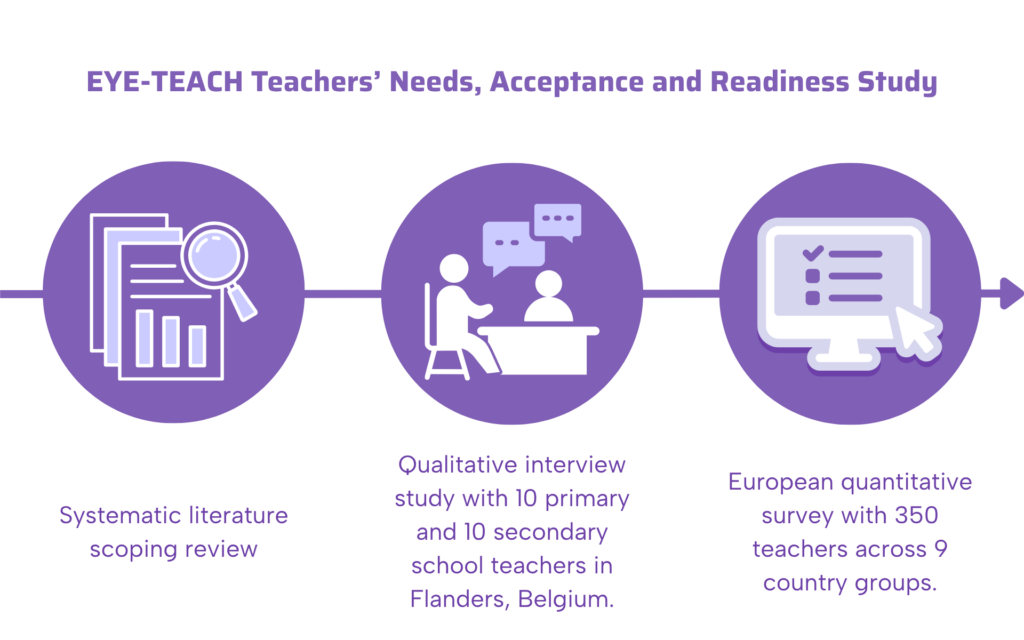
To this end, EYE-TEACH’s researchers embarked on a large international study to understand and map European teachers’ real needs with regards to AI-supported EdTech that uses eye-tracking data. EYE-TEACH also wanted to identify the extent to which teachers would accept to use such technologies, and whether they feel prepared to work with them. This approach has resulted in an unprecedented insight into European teachers’ perceptions and initial response to the concept of an AI-supported eye-tracking tool.
The results are in: what do teachers want?
Teachers are not opposed outright to AI-supported EdTech, but their willingness to use it clearly depends on a number of factors that go beyond whether the tool functions on a technical level.
(1) Teacher-in-control systems: Teachers show the strongest preference and trust for tools where the system supports their professional judgment, rather than fully automated systems that replace teachers in pedagogical decision-making. AI must enhance, not replace teachers’ human expertise in the classroom. Therefore, the tool EYE-TEACH develops must prioritize teachers’ control and agency, ensure that meaningful teacher-student interaction remains at the heart of education, and avoid over-automation of core education processes.
(2)Trustworthy and transparent: The tool must provide teachers with a clear understanding of how the system works, how it is generating its results, what students’ data is being used for, and where its limits lie. Questions of privacy, accountability, fairness, and data governance must be central to EYE-TEACH’s design and implementation process.
(3) Pedagogically fit-for-purpose: Teachers do not desire automation and innovation for its sake, but rather want to see this happen when and where it has educational value. Teachers recognise that the tool can have great potential in supporting quicker diagnosis, monitoring, and feedback in the classroom. However, reading instruction must remain a socially and pedagogically rich activity. It must not be reduced to students exclusively reading individually from screens so that their behavioural data is constantly tracked. Instead, the tool must be designed to be deployed in specific, targeted and pedagogically relevant ways, to complement but not replace reading instruction.
(4) Boosted by professional development training: Teachers will require a sustained investment in their professional learning for long-term uptake of AI-supported tools. This support must go beyond simply how to use the tool on a technical level, but address wider underlying concepts like pedagogical integration, how to interpret the system’s outputs, ethical reflections, and an understanding of what AI can and cannot do in an educational setting.
These results extend beyond the specific use-case tool that EYE-TEACH will develop. EYE-TEACH concludes that a broader European vision for AI in education must be guided not by automation alone, but by human-centered design, pedagogical relevance and fit, and ethically responsible implementation.
What next?
The EYE-TEACH research consortium will utilise these results as the basis upon which the EYE-TEACH system and tool will be designed and piloted. Subscribe to our Ecosystem newsletter and follow us on social media to remain updated and gain access to feedback and training opportunities that will be open to teachers in the coming 2 years.
– – – –
This blog summarises EYE-TEACH Deliverable 1.1: “Needs, Acceptance and Readiness Report” (2026), S. Buseyne; G. Joris; K. Tsiakas; T. van Daal; L. Catrysse; V. Donche; S. De Maeyer; H. Jarodzka; and D. Gijbels. Available on the EYE-TEACH website.